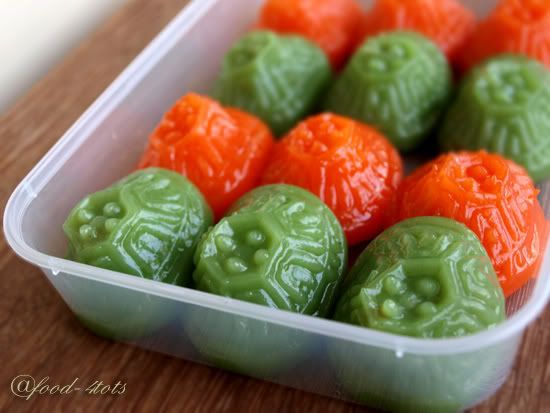
(Ang koo kuih from Eaton)
What is nyonya kuih?
Nyonya may be originated from the Portugese word "dona", which means "lady". It refers to female descendants of the early Chinese immigrants who settled in Penang, Malacca and Singapore.
Kuih is an Asian concept of cakes and pastries, different from that of the Western one in term of texture, flavour and appearance.
Kuih is an Asian concept of cakes and pastries, different from that of the Western one in term of texture, flavour and appearance.
******************************************************************************************************************
Ever since I left my hometown of Georgetown Penang for university studies, I developed a craving for authentic Nyonya cuisine and delicacies (especially nyonya kuih). Hence, whenever I return home for my holidays, the first time I do is to search out all the eating joints that serve Nyonya food. It was no exception during my recent holidays in Penang. My hubby happily tagged along as he too likes Nyonya food.
As both my hubby and son are big fans for ang koo kuih*, I took them to buy some from a shop at Batu Lanchang called Eaton. This shop is not only well known for its ang koo kuih but also its yellow glutinous rice with curry chicken and its special satay (without peanut sauce). They also provide full moon** celebration catering. My hubby gave 2 thumb-ups after savoring them. The kuih sold by this particular shop is different from others. If they are left open at room temperature, its skin remains soft and chewy even after 24 hours. The thickness of its skin was also perfectly done. The ingredients used were tasty, and not too sweet. The photo above shows a box of mini ang koo kuihs we packed before departing home.
*Ang koo kuih is a Hokkien pronunciation. Ang means red and koo means tortoise. It resembles the shape of a tortoise. For Chinese, tortoise symbolizes longevity. Hence, it is a popular item used for praying and full moon celebration. Its skin is made of glutinous rice flour. Usually those kuih with red-coloured skin is filled with mung beans and the green-coloured ones with “gula Melaka” coconut flakes.
** Full moon refers to a celebration held for a newborn when he/she turns one month old.
Below is the address of the shop. If you are coming from the opposite direction across the road, instead of crossing the road, you can also buy Eaton’s “kuihs” (savories) sold by a hawker in a coffee shop that faces exactly opposite Eaton's shop. It is a good business strategy as they cater to customers’ convenience from both directions.
Eaton Kuih Centre Sdn Bhd
Address: 110 & 139-M Jalan Tan Sri Teh Ewe Lim (Jalan Batu Lanchang), 11600 Penang.
Opening hours: 7.00am – 5.00pm
Tel: +604 2828355
Website: http://www.eaton.com.my/index.html
**************************************************************************************************************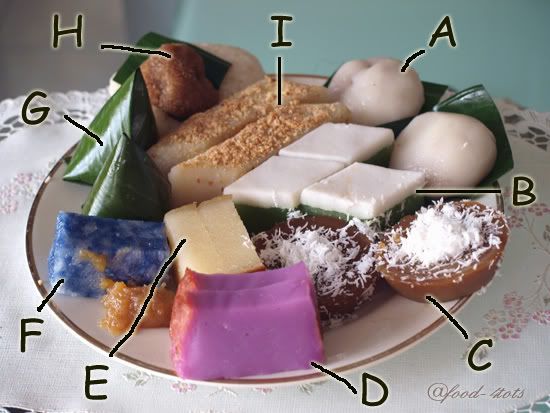
(Nyonya kuihs from Kheng Batu Lanchang Kaya & Nyonya Kuih)
A - Loh mai chi (glutinous rice ball with toasted peanut filling)
B - Kuih talam (it consists of two layers. The top white layer is made from rice flour and coconut milk, while the bottom green layer is made from green pea flour and extract of pandan leaf.)
C - Kuih ko sui (steamed rice pudding topped with grated coconuts)
D - Kuih bengkang bunga
E - Kuih bingka ubi (baked kuih of tapioca mixed in sweet pandan-flavoured custard)
F - Pulut tai tai (blue glutinous rice cake served with kaya)
G - Kuih kochi (pyramid of glutinuous rice flour filled with a sweet peanut paste and wrapped with banana leaf)
H - Pulut inti (glutinous rice topped with caramelised grated coconut flesh)
I - Chai tao kuih (made with grated radish(chai tao) and grounded spices (ketumbar), and topped with crushed peanut)
Besides Eaton, there is a hawker stall called Kheng Batu Lanchang Kaya & Nyonya Kuih located at the nearby Batu Lanchang market, which is famous for their assorted homemade nyonya “kuihs” and “kaya” (a sweetened bread spread made from coconut milk and egg). They sell as many as 30 types of “kuihs”. Some are even considered as “near extinct”, not easily found anywhere else. Prices are reasonable too. Being halal-certified, these delicacies are highly popular among muslim Malays. Indians are also frequent patrons of this stall.
On one afternoon, around 3.30pm, my hubby and I decided to buy some of the assorted “kuihs” from this hawker stall. It turned out that we were a bit early. At 3.45pm, there was still no sign of the stall owner. My first thought was it is closed for business on that day. However, I did a quick check with the stall owner in the adjacent stall to confirm if my hunch was wrong, I was told the “kuih” stall will indeed open that day. It made my feeling of disappointment turn hope. Shortly thereafter, 2 young girls strolled in to make preparation to open the stall. Then, came strolling in was a middle-aged man who pushed a cart loaded with 6 large trays of “kuihs” into the stall. Literally, in split seconds and to our surprise, out of the blue, a group of customers (about 10 people) rushed forward to the front of the stall to give their orders. Suddenly, the place came alive with hustle and bustle. The vendor was busy taking and packing orders. One customer even came holding his own container. My hubby was taken aback by the surging crowd (that looks more like a mob) clamoring to buy the “kuihs”, albeit was amused with the quick turn of the situation. As he is not fluent in the “Hokkien” chinese dialect, he asked me to proceed with our order. I managed to squeeze myself into the crowd which was getting more packed every minute. I didn’t expect to see such a huge crowd on normal weekday. Excuse me if I sound dramatic, but it was how both of us felt then. Guess how much I paid for all those “kuihs” shown in the photo? They only represent 80% of what I bought. The grand sum is RM8.00 (or USD2.20 equivalent).
Kheng Batu Lanchang Kaya & Nyonya Kuih
Address: Store No 29 Batu Lanchang Market
Opening hours: 3.30pm – 6.30pm (closed on Sundays)
Tel: +604 6589405
** Full moon refers to a celebration held for a newborn when he/she turns one month old.
Below is the address of the shop. If you are coming from the opposite direction across the road, instead of crossing the road, you can also buy Eaton’s “kuihs” (savories) sold by a hawker in a coffee shop that faces exactly opposite Eaton's shop. It is a good business strategy as they cater to customers’ convenience from both directions.
Eaton Kuih Centre Sdn Bhd
Address: 110 & 139-M Jalan Tan Sri Teh Ewe Lim (Jalan Batu Lanchang), 11600 Penang.
Opening hours: 7.00am – 5.00pm
Tel: +604 2828355
Website: http://www.eaton.com.my/index.html
**************************************************************************************************************
(Nyonya kuihs from Kheng Batu Lanchang Kaya & Nyonya Kuih)
A - Loh mai chi (glutinous rice ball with toasted peanut filling)
B - Kuih talam (it consists of two layers. The top white layer is made from rice flour and coconut milk, while the bottom green layer is made from green pea flour and extract of pandan leaf.)
C - Kuih ko sui (steamed rice pudding topped with grated coconuts)
D - Kuih bengkang bunga
E - Kuih bingka ubi (baked kuih of tapioca mixed in sweet pandan-flavoured custard)
F - Pulut tai tai (blue glutinous rice cake served with kaya)
G - Kuih kochi (pyramid of glutinuous rice flour filled with a sweet peanut paste and wrapped with banana leaf)
H - Pulut inti (glutinous rice topped with caramelised grated coconut flesh)
I - Chai tao kuih (made with grated radish(chai tao) and grounded spices (ketumbar), and topped with crushed peanut)
Besides Eaton, there is a hawker stall called Kheng Batu Lanchang Kaya & Nyonya Kuih located at the nearby Batu Lanchang market, which is famous for their assorted homemade nyonya “kuihs” and “kaya” (a sweetened bread spread made from coconut milk and egg). They sell as many as 30 types of “kuihs”. Some are even considered as “near extinct”, not easily found anywhere else. Prices are reasonable too. Being halal-certified, these delicacies are highly popular among muslim Malays. Indians are also frequent patrons of this stall.
On one afternoon, around 3.30pm, my hubby and I decided to buy some of the assorted “kuihs” from this hawker stall. It turned out that we were a bit early. At 3.45pm, there was still no sign of the stall owner. My first thought was it is closed for business on that day. However, I did a quick check with the stall owner in the adjacent stall to confirm if my hunch was wrong, I was told the “kuih” stall will indeed open that day. It made my feeling of disappointment turn hope. Shortly thereafter, 2 young girls strolled in to make preparation to open the stall. Then, came strolling in was a middle-aged man who pushed a cart loaded with 6 large trays of “kuihs” into the stall. Literally, in split seconds and to our surprise, out of the blue, a group of customers (about 10 people) rushed forward to the front of the stall to give their orders. Suddenly, the place came alive with hustle and bustle. The vendor was busy taking and packing orders. One customer even came holding his own container. My hubby was taken aback by the surging crowd (that looks more like a mob) clamoring to buy the “kuihs”, albeit was amused with the quick turn of the situation. As he is not fluent in the “Hokkien” chinese dialect, he asked me to proceed with our order. I managed to squeeze myself into the crowd which was getting more packed every minute. I didn’t expect to see such a huge crowd on normal weekday. Excuse me if I sound dramatic, but it was how both of us felt then. Guess how much I paid for all those “kuihs” shown in the photo? They only represent 80% of what I bought. The grand sum is RM8.00 (or USD2.20 equivalent).
Kheng Batu Lanchang Kaya & Nyonya Kuih
Address: Store No 29 Batu Lanchang Market
Opening hours: 3.30pm – 6.30pm (closed on Sundays)
Tel: +604 6589405